

Tech debt is like running a marathon with a backpack full of rocks. You may be running, but your speed - that is, your pace of running - is determined by how much legacy tech there is. Systems like old mainframes, antiquated Windows applications, and large VMware environments. You spend 30% of your time simply dealing with that dead weight and doing nothing else to build and deploy new features to production.
AWS Transform is the first enterprise agentic AI by AWS. This offering does not simply advise the customer but does the entire heavy lifting of evaluating, strategizing, and moving multiple legacy workloads (data and applications) to the cloud.
Know that whether you are a CTO who wants to eliminate the high costs of software licensing, or a DevOps lead that is attempting to advance an obsolete .NET monolith, you are the target audience, and this article will discuss AWS Transform, features, and pricing.
What Is AWS Transform?
AWS Transform is an AI-driven modernization service that helps enterprises move legacy workloads to modern, cloud-native architectures on AWS. At its core, it uses agentic AI; autonomous AI agents that can analyze existing applications, generate modernization plans, refactor code, and guide teams through execution using natural language.
Why Did AWS Build Transform?
Transform is different from other tools designed for a quick lift & shift migration. It reflects AWS's ambition to understand and execute a paradigm of modernization that addresses the recurring pain points of enterprises, especially:
Significant technical debt in legacy systems.
High consulting costs and the refactoring of code manually.
Shortage of skills in older technologies like COBOL and .NET frameworks.
Extended complex projects that run the risk of becoming a failure.
AWS Transform overcomes these challenges with AI that assists engineering teams and automates the work of tens of person-months.
Key Capabilities at a Glance
The service is designed to solve particular, high-friction workloads like the following:
Windows & .NET: Instead of paying licensing fees, you can modernize Linux-based .NET full-stack Windows apps.
Mainframe: You can use Java microservices to modernize and break apart COBOL monolithic applications.
VMware: WS Transform helps automate the transfer of your on-premises VMware to Amazon EC2.
Custom Code: You can use paid AI agent services to upgrade your code in restricted programming languages like Node.js, Java, and Python.
How AWS Transform Works
The magic of AWS Transform lies in its architecture. It combines generative AI with deep knowledge from 19 years of AWS migration experience.
Architecture: The Agentic Workflow
Rather than having one AI that has to do everything, AWS Transform has separate, specialized agents. So, for example, if you are modernizing a Windows workload, there is a Windows agent that is assigned the task.
Discovery & Assessment: The agent connects to your environment (via a secure connector) and scans your codebase, databases, and infrastructure. It maps out dependencies, such as App A is dependent on a particular stored procedure in Database B.
Planning: The agent presents a "Wave Plan" proposal. This is a comprehensive roadmap that outlines which applications should be migrated together to avoid disruption.
Execution & Validation: When the plan is approved, the agent starts the work. It refactors code, changes the database schema to be compatible with the new application, and creates test scripts to validate that the new application functions the same as the one that was deprecated.
Collaboration Workspaces
All team members must work together to achieve modernization goals. AWS Transform provides Workspaces to provide a place to collaborate for cross-functional teams (developers, architects, and security leads). You can communicate with the AI and inquire about, “What dependencies does this module have?” or “Please create a test plan for this migration.”
Human-in-the-Loop Governance
Most importantly, the AI does not simply take over. AWS Transform uses a HITL model. The agents can recommend a change, but for important actions, a human supervisor must assess and authenticate (merging to the main branch, deploying to production), and you still have ultimate authority while the AI does the work you don't want to do.
Key Features & Benefits
Why are enterprises rushing to adopt this tool? The results speak for themselves. Early adopters have reported modernizing workloads up to 5x faster compared to manual methods.
1. AI-Driven Automation
When you automate dependency mapping and code refactoring, you allow more of your developers to focus on innovation. In the case of VMware migrations, AWS Transform offers a network configuration conversion that is 80x faster than a human engineer.
2. Massive Cost Reductions
One of the biggest drivers for modernization is the cost of legacy licensing. Companies spend up to 70% less on operational costs by moving from proprietary databases such as SQL Server to free, open-source databases such as Amazon Aurora PostgreSQL.
3. Scalability
When it comes to manual modernization, it is almost always done one app at a time. AWS Transform, however, lets you do parallel transformations, modernizing hundreds of applications simultaneously and without exhausting your staff.
4. Comprehensive Testing
A common fear in migration is, “What if it breaks?” The service addresses this by developing and validating test suites and control sets. In the case of mainframe projects, it can create a test data collection system to ensure that your new Java system performs the same functions as your old COBOL mainframe system.
AWS Transform Pricing
AWS has made it easy to start using their services and has therefore made it easy to start using Transform without hesitation. They have made the pricing structures extremely favorable.
Free Tier Workloads
Currently, AWS has no fees to be billed for migration and modernization agents for workloads such as
Assessments: Free.
Windows Modernization Agent: Free.
Mainframe Modernization Agent: Free.
VMware Migration Agent: Free.
Although AWS Transform agents are free, the resource utilization for the standard AWS infrastructure will be billed to include:
Amazon EC2
Amazon Aurora or Amazon RDS
Storage, networking, and related AWS services
This matches AWS’s standard pricing approach: the intelligence layer is free, while infrastructure usage is billed normally.
Paid Feature: Custom Transformation Agent
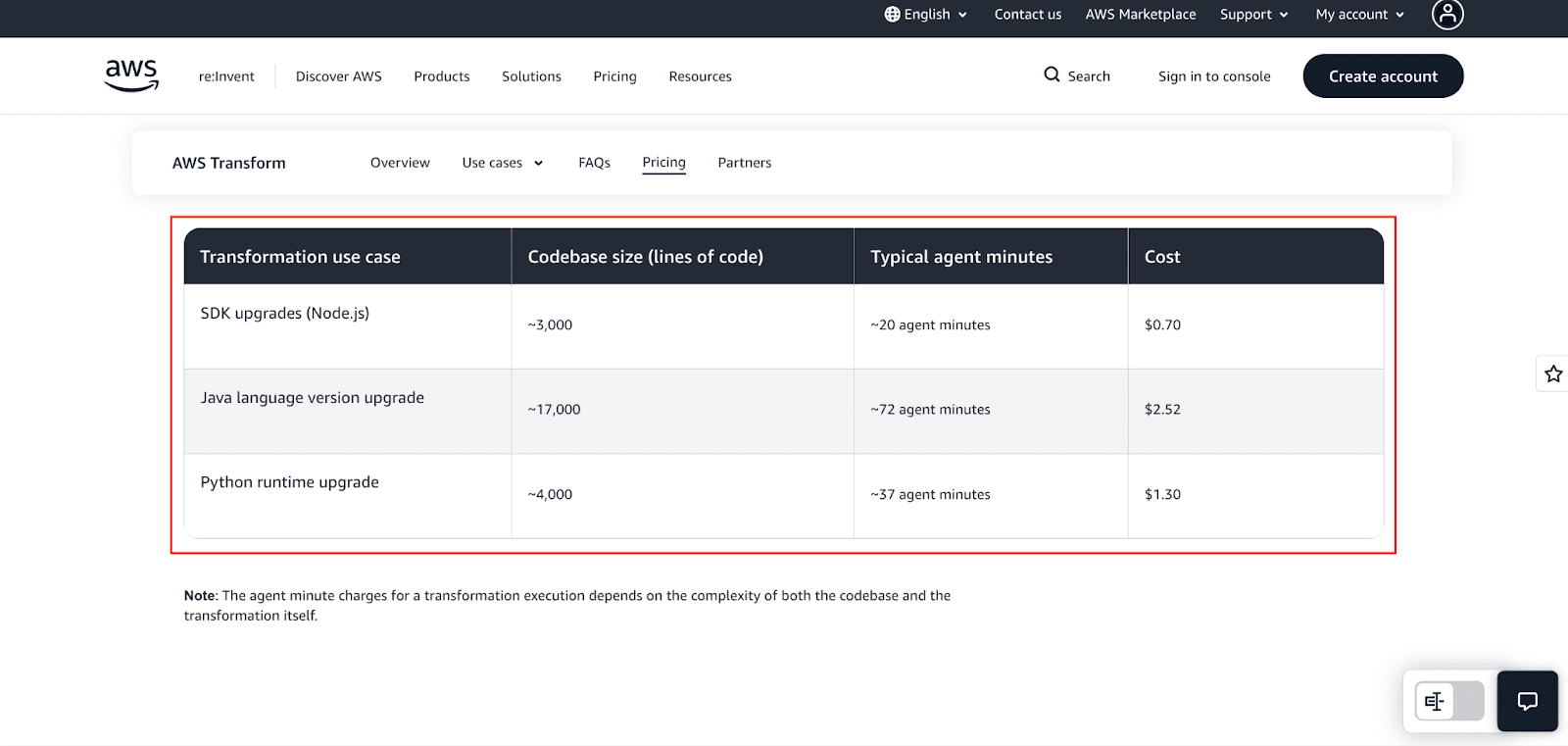
This feature is also paid and is used to handle special cases like updating a Python runtime or making a complicated architectural change on a custom application.
Pricing Model: You are charged per agent minute.
Cost: $0.035 per agent minute.
Billing Logic: You only pay when the agent is actively planning, reasoning, or modifying code. You are not charged for user idle time or local machine operations like file reads.
Example Calculation:
Consider a situation where you are required to update a Java application with about 17,000 lines of code.
In order to analyze and revise the code, the agent spends 72 minutes.
Total Cost: 72 minutes * $0.035 = $2.52.
Compared to the hourly rate of a senior consultant or the time cost of a developer manually rewriting code, this pricing is incredibly competitive.
Who Should Use AWS Transform?
AWS Transform is ideal for:
Large enterprises with legacy systems
Organizations planning multi-year modernization programs
Teams facing skills shortages
CTOs focused on cost optimization and speed
It may be less suitable for:
Small startups with modern stacks
Simple lift-and-shift migrations
Conclusion
If your company is sitting on a goldmine of data locked into legacy systems, or if you are spending budget on overly extended support for legacy Windows Servers, AWS Transform is a no-brainer.
AWS Transform is the tool that removes the technical grunt work of modernization projects, the type of work that kills them. With agentic AI, the focus is not merely on cloud migration, but on business “refactoring” to make it AI-ready.
FAQs
1. Is AWS Transform free to use?
AWS Transform offers free agent support for evaluation and basic modernization scenarios. However, there are costs associated with advanced or customized transformation agents, and of course, the standard usage fees for AWS services.
2. How is AWS Transform different from AWS Migration Hub?
AWS Migration Hub is intended to help with the monitoring and management of migrations. AWS Transform is centered on AI-enabled modernization of applications (that is, refactoring and transformation).
3. Can AWS Transform replace consulting partners?
AWS Transform minimises the requirement for consultative assistance in analysis and refactoring to a great extent. However, a considerable number of organizations depend on their partnerships for governance, architecture, and change management.
Join Pump for Free
If you are an early-stage startup that wants to save on cloud costs, use this opportunity. If you are a start-up business owner who wants to cut down the cost of using the cloud, then this is your chance. Pump helps you save up to 60% in cloud costs, and the best thing about it is that it is absolutely free!
Pump provides personalized solutions that allow you to effectively manage and optimize your Azure, GCP, and AWS spending. Take complete control over your cloud expenses and ensure that you get the most from what you have invested. Who would pay more when we can save better?
Are you ready to take control of your cloud expenses?