All blogs
10 mins
Azure Managed Redis: What It Is, Pricing & Features
Stuart-Lundberg


Modern apps require rapid response times. Users expect results to happen almost instantaneously after a button click. Traditional databases handle growing apps poorly, which causes the databases to show poor performance. Developers implement caching to fix these issues, and the most advanced tool available is coming from Microsoft.
So, what is Azure Managed Redis? In short, it is a fully managed, in-memory data store to speed up your apps and provide a positive user experience. Azure Managed Redis is built on Redis Enterprise and provides faster performance compared to the older caching solutions.
In this article, we will discuss the core features of Azure Managed Redis, how it is priced, and how it stands against the older version of Azure Cache for Redis.
What Is Azure Managed Redis?
Azure Managed Redis is a fully managed service on Azure built on top of Redis Enterprise software. It acts as a high-speed short-term memory bank for your application. Instead of your app having to pull information from your main database, your app can pull the information from Redis instead.
Microsoft’s Redis products are designed to provide next-generation Redis solutions for real-time applications, caching, and AI workloads. Microsoft Azure Redis is designed to deliver the latest innovations in Redis, enabling developers to create the best products.
Azure Managed Redis Architecture
In order to better understand Microsoft Redis and why it is so fast, we can look at its architecture.
In-memory caching: Data is stored in RAM instead of on a physical storage drive. Therefore, it can be accessed in microseconds.
Multi-threaded processing: Unlike the earlier versions that handled commands one at a time, microarchitecture can process commands simultaneously.
Clustering: Data is automatically distributed across several nodes so that one single point of failure will not crash the entire application.
Why Azure Managed Redis Was Introduced
To keep pace with rapid technological and infrastructural advancements, Microsoft has developed this service due to previous caching solution limitations and to prepare businesses with predictive technology capabilities driven by AI.
Problems with Azure Cache for Redis
Legacy Azure Cache for Redis was beneficial for developers for several years, but modern workloads brought to light several glaring issues:
Single-threaded limitations: Being older architecture, they could only handle one operation at a time, and because of this, the system would become clogged at peak hours of demand.
Scaling complexity: Significant effort and downtime were required to move between performance tiers.
Legacy architecture: The needed underlying structure was distributed and global, so the flexibility was lacking for the global applications.
Azure Managed Redis Key Features
Azure Redis offers a comprehensive variety of tools that simplify app development and boost performance.
Fully Managed Service
Your workers will no longer have to spend time keeping caches up and running. Microsoft automates the heavy lifting.
Automatic updates: The newest software versions are automatically uploaded to the system.
Patching: The system automatically handles manual patches to close security vulnerabilities.
Monitoring: Built-in tools integrate seamlessly with Azure Monitor to track performance.
High Availability
To keep your applications online, Azure Redis Managed Cache uses advanced redundancy, so they minimize the downtime to a minimum.
Multi-zone deployment: Physical data centers are used to distribute nodes.
Automatic failover: Data flow consistency is preserved as a replica takes control as soon as primary node control is lost.
High Performance
Redis is the preferred choice for developers due to its remarkably fast performance.
Sub-millisecond latency: Data retrieval is measured in milliseconds.
In-memory data storage: Bypassing conventional disk storage systems opens up immeasurable speed by storing data in memory.
Enterprise-Grade Security
Safeguarding your data is a key element to the protection offered by the platform.
Private endpoints: Your data remains on the private Azure network.
TLS encryption: Your data is encrypted both in transit and at rest.
VNet integration: Your cache is removed from the public internet.
Scalability
As your business expands, your cache is able to grow.
Horizontal scaling: Add more nodes to share the workload.
Clustering: You can easily divide large datasets among different servers.
AI-Ready Features
New applications call for specific data management, especially when using machine learning models.
Vector caching: Fast storage and retrieval of vector embeddings for generative AI.
Semantic caching: Cache responses to serve the most relevant to the context of user queries.
LLM memory: For Large Language Models (LLMs), context and chat history are maintained with negligible latency.
Azure Managed Redis Pricing
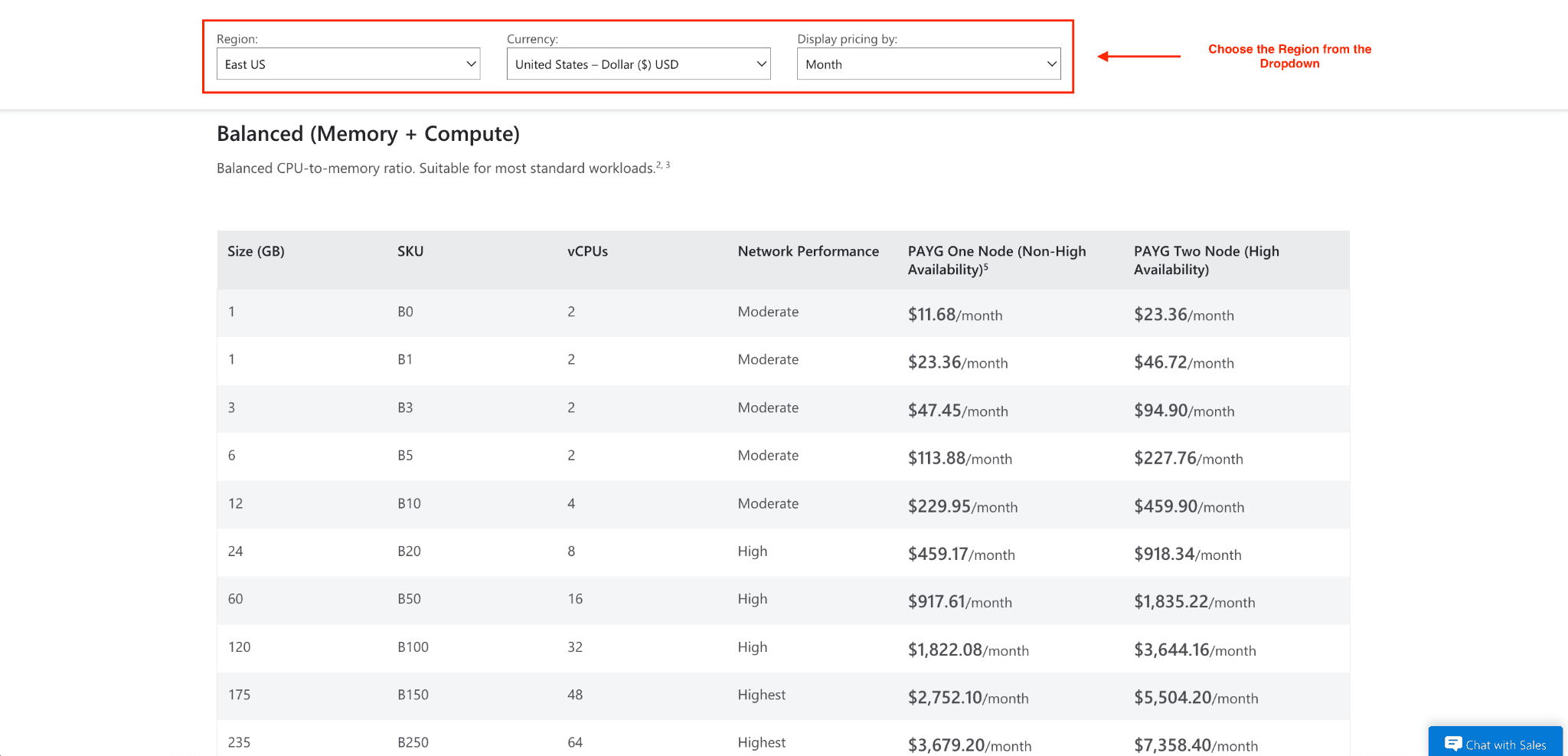
Understanding costs is crucial for any cloud deployment. Azure Managed Redis uses a flexible, pay-as-you-go model, allowing companies to pay only for the resources they consume.
Azure Managed Redis Pricing Factors
Several elements influence your monthly costs:
Memory Size: The amount of RAM you allocate to your Redis instance.
Performance Tier: Different tiers offer varying compute-to-memory ratios.
Region: The geographical location of the Azure data center will determine pricing.
Availability Zones: Adding more zones increases costs but increases resiliency.
Throughput: High-performance configurations come with a higher price tag.
Networking: Features like private endpoints and VNet integration can affect your bill.
Azure Managed Redis Pricing Tiers
Microsoft provides four distinct SKUs to match your workload requirements:
Tier | Best For | Typical Starting Price | Large-Scale Pricing |
Balanced | General workloads | ~$50–$150/month | $500–$3,000+/month |
Memory Optimized | Large datasets | ~$150–$300/month | $1,000–$6,000+/month |
Compute Optimized | High throughput | ~$200–$400/month | $2,000–$8,000+/month |
Flash Optimized | TB-scale datasets | ~$400+/month | $5,000–$15,000+/month |
Here are some example pricing scenarios for different deployment sizes:
Small Redis cache: ~$40–$100/month
Medium workload: ~$150–$800/month
Enterprise workloads: $1,000–$10,000+/month
Additional Azure Managed Redis Costs (Important)
Azure Managed Redis has additional costs beyond what is described in most guides. Here is what costs you can expect:
High Availability & Redundancy Costs: If you enable high availability or multi-zone zones, this could increase your costs by as much as 30-100% because you will be paying for additional nodes.
Data Transfer Costs: Azure charges for outbound data transfer; these charges could include costs of cross-region replication, data egress, and multi-region deployments.
Geo-Replication Costs: If you are using active geo-replication for disaster recovery, you are responsible for costs associated with the secondary Redis instances and data transfer across regions.
Networking Costs: If you use private endpoints, or integrate with a virtual network, or use load balancing, these will incur additional charges that are billed separately from your Redis instance.
Monitoring & Logging Costs: Monitoring isn't always free, and Azure Monitor charges for data ingestion, storage of metrics, and alerts, so be conscious of your usage.
Azure Managed Redis Cost Optimization Tips
To avoid excessive costs, follow these recommendations:
Use smaller instances: Start at a lower-tier instance and scale up when your metrics are clear.
Monitor usage: Memory consumption will need to be monitored regularly through Azure Monitor.
Enable auto-scaling: Let the system dynamically adjust resources to meet demand, so enable auto-scaling.
Use Reserved Pricing: Discounts for reserved pricing are available for long-term usage and will be your best way to keep costs down. Azure Managed Redis prices will cost 20-40% less when you reserve for 1 to 3 years, depending on your usage.
Why Azure Cache for Redis Is Being Replaced by Azure Managed Redis
Microsoft has decided to retire Azure Cache for Redis and recommend all users migrate to Azure Managed Redis, which is a next-generation Redis service. Managed Redis has a new cloud-first architecture to provide better scalability and improved performance, which is important for today's cloud and AI-powered apps.
Here's the official retirement timeline:
Azure Cache for Redis Enterprise / Enterprise Flash: March 30, 2027
Azure Cache for Redis Basic, Standard, Premium: September 30, 2028
Before these dates, Microsoft suggests moving to Azure Managed Redis to get better performance, scalability, and modern features. This change is part of Microsoft's larger move toward a cloud infrastructure that can handle more users and is ready for AI.
Azure Managed Redis Use Cases
Application Caching: Caching frequently accessed records like product catalogs or user profiles reduces the burden on your primary database.
Session Storage: You can store user sessions, shopping carts, and authentication tokens for quick retrieval.
Real-Time Analytics: You can power live dashboards and metric tracking to ensure your BI tools remain constantly updated.
Rate Limiting: Protect your APIs by tracking user requests and server traffic to prevent overloading the server.
AI Applications: Generative AI applications benefit from rapid retrieval of saved LLM responses, chat history management, and fast semantic search.
When Should You Use Azure Managed Redis
You can consider Azure Managed Redis if you have the following needs:
You need consistently low latency.
You are building real-time applications like chat apps or live gaming leaderboards.
You run microservices that require a fast message broker.
You are looking to implement caching across several geographical areas.
You create intricate, agile AI applications.
When Not to Use Azure Managed Redis
Caching solutions are not the answer to every data issue. Do not use this service if:
You require complex data aggregation with a highly structured, relational database.
You need a system that is designed for long-term, permanent data retention.
You need infrequently accessed data storage at the highest cost.
You are doing advanced analytics on batch-processed data warehouses.
Azure Managed Redis Best Practices
To get the most out of your caching layer, apply these fundamental practices to your architecture.
Use TTL for Cached Data: Set a TTL on your cache keys to allow stale data to automatically expire. This will help to free up memory so that fresh data can be added.
Monitor Memory Usage: Monitor the memory usage of your cache to make sure the memory does not reach its limit. This will help to avoid your system evicting important data or rejecting new writes, which causes unpredictable errors in your application.
Use Clustering for Scale: If your application has huge spikes in traffic, instead of relying on just one huge instance, use clustering to divide the work across multiple nodes.
Use Private Networking: You can protect your data by using Azure Private Link to ensure that your cache can only be accessed through your private virtual network and is not available on the public internet.
Implement Backup Strategy: Even though a cache is used for temporary data and will normally lose data when a cache is unavailable, the loss of data can create a sudden spike in overwhelming traffic to your primary database. You can use Redis data persistence to create a snapshot on the disk to recover quickly.
Conclusion
Azure Managed Redis is a big step forward for caching modern apps and processing data in real time. It can handle low-latency workloads, microservices, and AI-driven apps because it has fast memory and a scalable architecture.
Using Azure Managed Redis can help companies improve performance, lower the load on their databases, and make managing their infrastructure easier. If your apps are running slowly, checking out Azure Managed Redis can help you figure out if it's the right fit for your needs.
Join Pump for Free
If you are an early-stage startup that wants to save on cloud costs, use this opportunity. If you are a start-up business owner who wants to cut down the cost of using the cloud, then this is your chance. Pump helps you save up to 60% in cloud costs, and the best thing about it is that it is absolutely free!
Pump provides personalized solutions that allow you to effectively manage and optimize your Azure, GCP, and AWS spending. Take complete control over your cloud expenses and ensure that you get the most from what you have invested. Who would pay more when we can save better?
Are you ready to take control of your cloud expenses?