All blogs
10 mins
Amazon Rekognition: What It Is, Features & Pricing
Piyush-Kalra


The development of AI technologies has disrupted companies' image and video analysis. Companies still using manual image processing know how slow, inaccurate, and costly it is. Modern applications require quick and efficient automated image processing, offering significant benefits over time and resources.
Amazon Rekognition is part of the solution. Unlimited visual analysis capabilities can be integrated into applications, with no need to build and implement complex machine learning models.
In this article, I will explain exactly what Amazon Rekognition is, outline its most powerful features, and break down the pricing structure so you can confidently evaluate it for your next project.
What is Amazon Rekognition?
Amazon Rekognition is a fully managed, cloud-based AI service that allows users to detect and analyze objects and scenes in images and videos using machine learning models. Users don't need to hire data scientists to analyze the images and videos. Models are available as completed and trainable.
Using only an API for Rekognition, customers are able to analyze and obtain the relevant information about the images and videos in real-time. The different models available include the following:
Face detection and analysis
Object and scene detection
Text detection (OCR)
Video analysis and tracking
Content moderation for unsafe imagery
Companies can adopt and use Rekognition for various purposes. Firstly, it frees up human resources in performing content moderation, which impacts security and enhances it through the use of face verification. Second, it uses deep analytics to analyze and catalog objects in images and videos. Lastly, it can be used to ensure compliance with different regulatory frameworks by analyzing images and videos and filtering out user content that is inappropriate or illegal.
Key Features of Amazon Rekognition
Amazon Rekognition has highly accurate and pre-trained capabilities. Here are some of the best features for you to customize to your needs.
Face Detection and Recognition
Identification of faces on images and videos is possible with a high level of accuracy using this feature. You can also verify a person’s identity by comparing their selfie to a stored ID. Additionally, the API provides analytics on facial features and attributes, including their gender, ethnicity, age (in terms of a certain age range), and expression, among others.
Object and Scene Detection
Amazon Rekognition is able to identify thousands of standard objects, including, but not limited to, vehicles, animals, and pieces of furniture. It also detects broader scenes like a beach, a city street, or a parking lot. This feature makes it possible to easily and automatically tag and sort voluminous images.
Text Detection (OCR)
Amazon Rekognition makes text extraction from images a simple task. Easily capture street signs, license plates, and text (including phrases and sentences) that overlay images and videos. This is very beneficial to a company when it needs to process documents and account for references to its brand on social media.
Content Moderation
In case you run a system that relies heavily on user-generated content, you need to take extra care to moderate the interactions that occur in that platform. Amazon Rekognition is able to identify unwanted, inappropriate, and offensive elements. It is possible to automate content moderation within the API to help ensure a positive user experience. Such a task is possible for users to accomplish through the use of API filters.
Video Analysis
Beyond static images, Amazon Rekognition performs ongoing video analysis on them. It is able to watch the movement within a stream in real time, pinpoint and identify certain actions (like someone delivering a package), and recognize when a certain individual (like a celebrity) appears in the stream.
How Amazon Rekognition Works
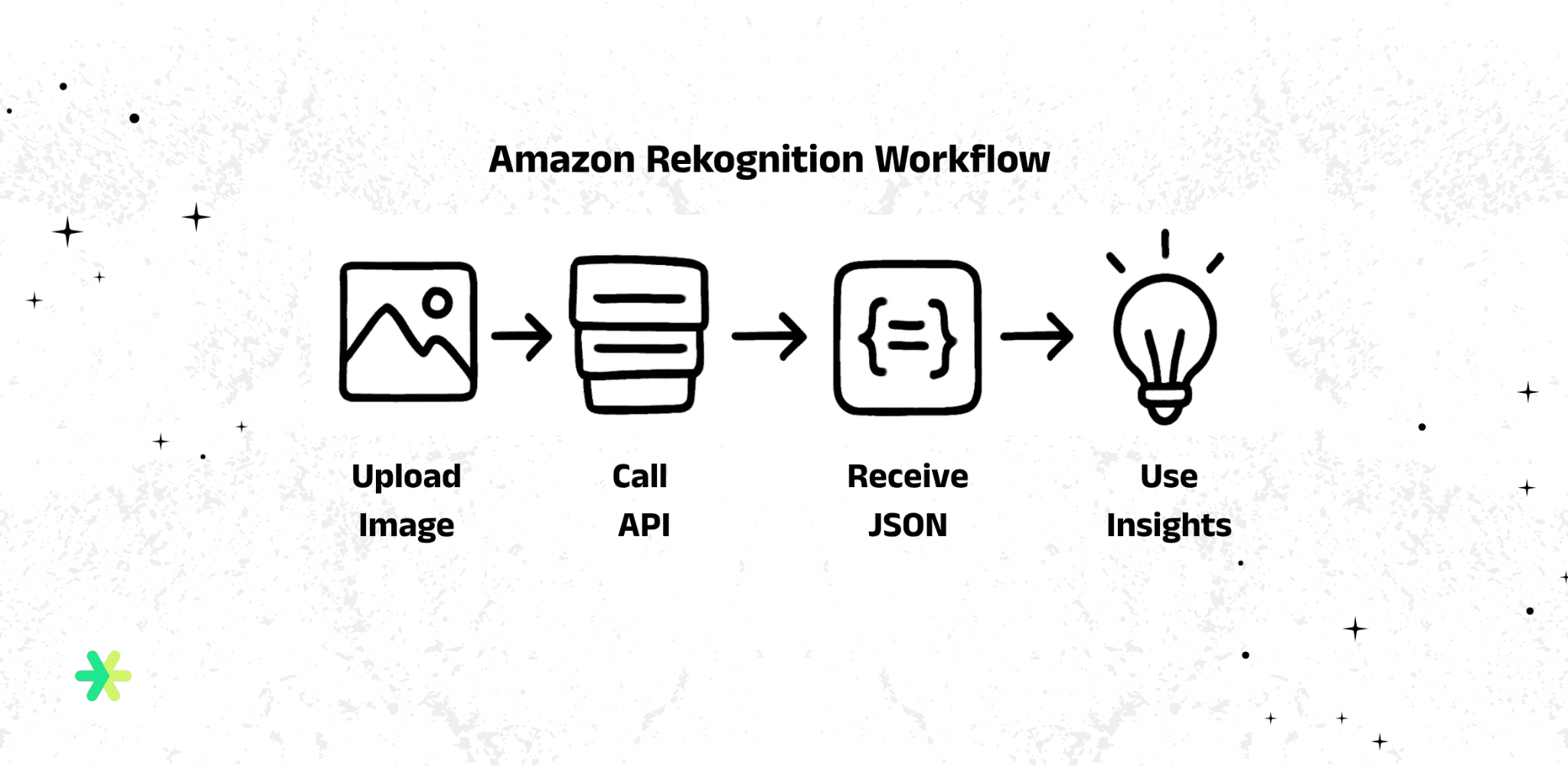
Think of Amazon Rekognition as a digital librarian that analyzes a photo and produces a list with stats about what’s inside. In Rekognition’s case, this list includes predictors about what’s inside and how confident the librarians are.
Here’s how the application works, step-by-step.
Upload media: You upload a picture or a video into a bucket in Amazon S3.
Send API request: Your application makes a call to the Amazon Rekognition API.
AI analysis: In a few milliseconds, the deep learning models of AWS do the visual data processing.
Results returned: The API sends a reconstructed JSON file that contains all the requested elements like the labels, bounding boxes, and confidence scores.
The system handles the architecture for you, and that's crucial. You get to process millions of images at the same time without having to manage the infrastructure yourself because the system uses Amazon S3 for storage and serverless Lambda functions to invoke the Rekognition API.
Amazon Rekognition Use Cases
Amazon Rekognition allows companies to create smarter, safer, and more efficient applications. Here are some common applications of the technology.
Security and Surveillance: Companies use facial recognition APIs to set and manage physical access control for different buildings. The APIs can also be used to detect whether a person leaves a package unattended and whether an unauthorized person is in restricted access zones.
E-Commerce: Retailers can use visual search engines to enhance customer experience. Visual search engines allow customers to upload an image of an item and find it in the store. It can also auto-tag thousands of product photos.
Social Media: Social media APIs use this service for large-scale automated content moderation and facial recognition for automated photo tagging.
Media and Entertainment: Video taggers enable broadcasters to catalog scenes and technical operations, such as silent black frames, and facilitate content discovery.
Healthcare and Safety: Rekognition is used in hospitals to verify patients' identities and in some industries to detect whether staff are wearing the correct Personal Protective Equipment (PPE).
Amazon Rekognition Pricing
Amazon Rekognition offers a pay-as-you-go pricing model, similar to most AWS services. This means there are no upfront fees, no minimum commitments, and you are not charged for idle time. You pay only for the images or videos you analyze. Pricing varies based on:
Type of API used
Number of images analyzed
Video minutes analyzed
Storage of face metadata
Pay-As-You-Go Pricing Example
For image analysis, pricing varies depending on the API group. AWS uses volume-based pricing, so the cost per image decreases as usage increases.
Here is an example of the US East (N. Virginia) region pricing for standard image analysis:
Usage Tier | DetectLabels, Moderation, Text (Group 2) | CompareFaces, Face Search (Group 1) |
First 1 million images | $0.001 per image | $0.001 per image |
Next 4 million images | $0.0008 per image | $0.0008 per image |
Next 30 million images | $0.0006 per image | $0.0006 per image |
Note: Storing face metadata for recurring searches costs about $0.00001 per face per month.
Video Analysis Pricing
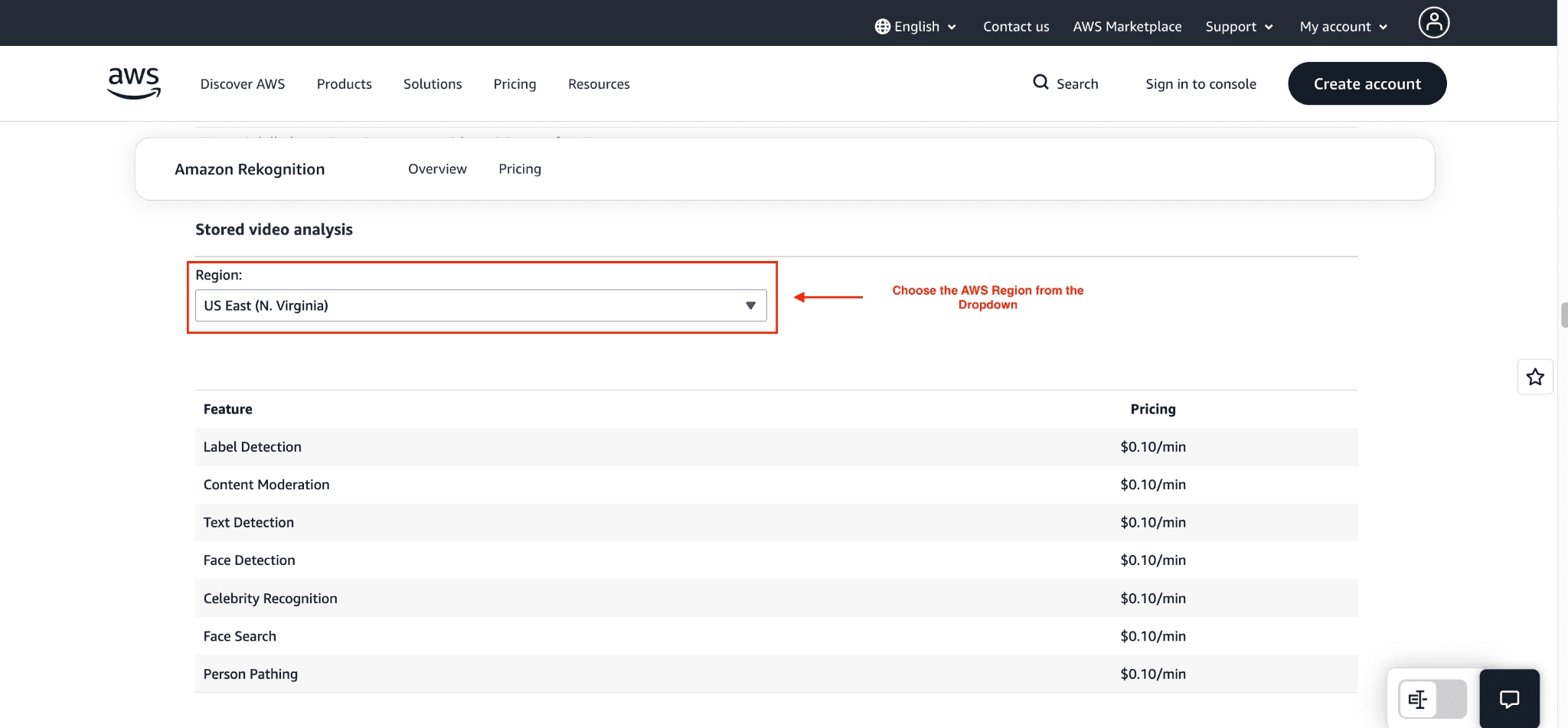
When it comes to video analysis, Amazon Rekognition charges you for each minute of video processed.
Let's say you are analyzing the security footage. Rekognition can do that by automatically detecting certain objects (label detection), recognizing the faces (face detection), identifying the inappropriate content (content moderation), or tracking the individuals (person tracking) as they move in the video.
Pricing for these standard video analysis features typically starts at $0.10 per minute of video. This rate is subject to change based on the AWS region you are using.
Custom Labels Pricing
For Amazon Rekognition Custom Labels, pricing is based on the ability to teach models for specific cases. Being able to identify specific logos for your company or certain machine parts for your line.
The two primary factors that determine custom label pricing are:
Training hours: You are charged for the hours needed to train the model you created.
Inference hours: You are charged for hours the model needs to process images or videos.
Free Tier Options
There are quite a few ways to test Amazon Rekognition for free. With the AWS Free Tier, you can analyze:
Up to 1,000-5,000 images per month (depending on the API)
60 minutes of video per month
As a new AWS customer, you can also receive up to $200 in free credits across AWS services linked to Amazon Rekognition. This lets you test pilot AI-powered video/image analysis without upfront investment.
How to Use Amazon Rekognition
The first step in automated visual analysis is basic because there are only a few steps required.
Go to Amazon Rekognition on the AWS console.
In Amazon S3, create a bucket to store the images and videos you want to analyze.
Use the AWS SDK (offered in the programming languages like Python, Java, Node, etc.) to create and run code to send the S3 objects to the Rekognition API.
Save or display the information from the script your code receives, along with the AI findings, in the form of a JSON file to your database.
When Should You Use Amazon Rekognition?
The Amazon Rekognition service has some amazing capabilities, but you should be aware of its specific features.
Rapid facial recognition and comparison for security purposes.
Safe image and video moderation to ensure community safety.
Server management and scalable video analysis.
Any form of primary object recognition or basic visual search.
When Amazon Rekognition May Not Be Ideal
Despite it being powerful, there are several situations that may not suit this service:
You need offline processing: Amazon Rekognition needs to stay connected to the internet to communicate with the AWS Cloud.
You need extremely niche accuracy: If you are focusing on particular medical issues or tiny manufacturing errors, you may want a custom-designed ML for that from scratch.
You have strict privacy restrictions: A cloud-based API is not suitable for your compliance needs if local laws or company policies require that media data remain on your on-premises servers.
Conclusion
Amazon Rekognition is one of the simpler ways for your company to utilize deep learning. With its pre-trained models for object detection, facial analysis, text extraction, and content moderation, you will save a lot of time from manual processes and be able to create more intelligent and responsive applications. The free tier and pay as you go model makes it easy to test the service.
Are you ready to try automated visual intelligence? Make an AWS account, and go to the Amazon Rekognition console.
Join Pump for Free
If you are an early-stage startup that wants to save on cloud costs, use this opportunity. If you are a start-up business owner who wants to cut down the cost of using the cloud, then this is your chance. Pump helps you save up to 60% in cloud costs, and the best thing about it is that it is absolutely free!
Pump provides personalized solutions that allow you to effectively manage and optimize your Azure, GCP, and AWS spending. Take complete control over your cloud expenses and ensure that you get the most from what you have invested. Who would pay more when we can save better?
Are you ready to take control of your cloud expenses?