
Choosing the right messaging service in AWS is extremely complicated and challenging. Routing complicated services such as Amazon Simple Notification Service and Amazon EventBridge can result in confusion and misrouting of events in applications. Both services are critical in designing scalable and event-driven services. However, they cater to different problems, and their implementation serves a different need.
Choosing the wrong messaging service can lead to increased costs, operational overhead, or architectural limitations later on.
In this article, the differences between AWS EventBridge and SNS will be explained. This will be followed by a comparison of the pricing of the two services and the provision of use-case scenarios to assist you in determining which one will suit your project best. At the end of this article, you will have a clear picture of the operation of each service and the situations to apply one in favor of the other, and possible scenarios to use them in parallel.
What is AWS EventBridge?
AWS EventBridge is a service that acts as a well-organized, centralized switchboard for your applications. It can be described and functions as a serverless event bus service that captures, stores, filters, and directs events from a range of different sources to a different destination.
EventBridge’s event bus forms the backbone of the service and is the component responsible for the ingestion and delivery of events according to the rules the user configures. Each rule contains an event pattern, which acts as a filter to determine which of the target endpoints, such as AWS Lambda functions, SQS queues, or SNS topics, will receive the event. Based on this functionality, the service can be leveraged for highly complex event-driven architectures.
What is Amazon SNS?
Amazon SNS is a fully managed publish/subscribe (pub/sub) messaging service. Imagine it as a broadcast tower. When a publisher sends a single message, all subscribers to the SNS topic will, at once, receive the message. This fan-out architecture is designed to allow for high volume throughput on a real-time message broadcasting/streaming.
Subscribers to the SNS topics can be of all varieties, including:
AWS Lambda functions
SQS queues
HTTP/S endpoints
Email addresses
Mobile push notifications (SMS)
Amazon SNS is designed to help developers simply decouple their applications as well as allow for the unbounded scale, as it allows developers to notify hundreds of endpoints in a flash; there is no infrastructure to weigh down the development.
Core Differences: EventBridge vs. SNS
Although both services are able to distribute messages, the architecture as well as the core functions of both services are fundamentally different.
Feature | Amazon EventBridge | Amazon SNS |
Primary Model | Event Bus (Many-to-Many Routing) | Pub/Sub (One-to-Many Fan-Out) |
Filtering | Advanced, content-based filtering via rules | Basic, attribute-based filtering |
Integrations | Native support for AWS services & 3rd-party SaaS | Primarily AWS services & standard endpoints (HTTP, email) |
Schema | Built-in Schema Registry for discovery and validation | No schema management |
Delivery Guarantee | At-least-once | At-least-once (for most targets) |
Availability SLA | 99.99% | 99.9% |
Messaging Architecture
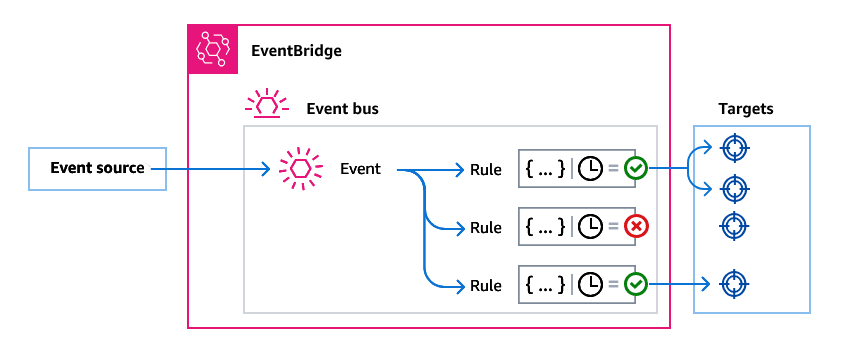
Source: AWS EventBridge
EventBridge employs an event bus model. EventBridge acts as a central router to which many sources can be plugged, and EventBridge can route to many targets. It is a sophisticated architecture where component pieces of a system can react to events without direct knowledge of each other.
While SNS also has a publish/subscribe architecture, it employs a simpler architecture than EventBridge. In SNS, a publisher sends a message to a topic, which the topic sends to all subscribers, so it is more of a one-to-many architecture than EventBridge.
Event Filtering and Routing
EventBridge's content-based filtering system is the most advanced. You can create complex rules on EventBridge and leverage its features to inspect the entire JSON event payload. E.g., a rule could route an order event to the shipping service if the status is “paid” and the shippingMethod is “express.”
SNS filtering works differently as it is attribute-based. You can add metadata (String or String.Array) to a message, and subscribers can opt to receive messages that only contain certain attribute values. Deep event inspection is far more flexible than SNS filtering.
Supported Targets and Integrations
EventBridge boasts its native third-party SaaS integrations. It can receive events from third-party SaaS platforms directly (e.g., Shopify, Datadog, and PagerDuty), providing seamless connections between your external tools and AWS.
SNS also supports an extensive list of endpoints, but it is mostly centered around AWS services and direct notification channels like SMS and Email. Connecting to a third-party service most of the time requires an additional piece/component, like a Lambda function.
Cost Comparison: EventBridge vs. SNS
To understand EventBridge and SNS pricing policies to mitigate unanticipated costs. Both EventBridge and SNS have different pay-as-you-go policies, but what you pay for differs.
EventBridge Pricing Structure
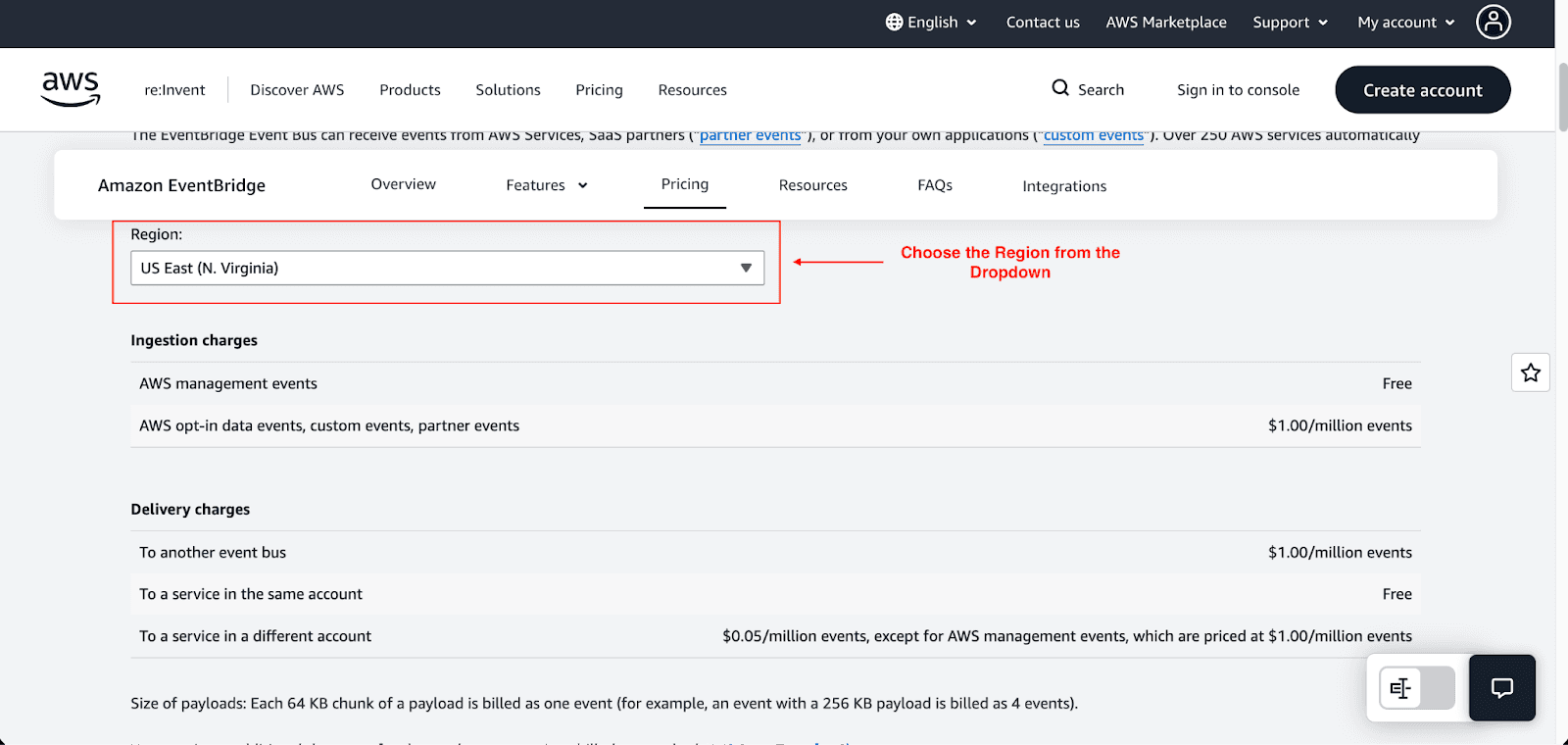
Eventbridge pricing depends on how many events are published within the service, the types, and their payload sizes:
Event Ingestion: 1 million custom or partner events are $1.00 and are capped at 64 KB each. Ingestion for “management events” (from the same AWS account) is free.
Event Delivery: Delivery within the same account is often free, but there are charges for cross-account or cross-bus deliveries, which can start at $0.05 and increase for each million events.
Free Tier: 1 million events published monthly from custom applications or third-party SaaS partner services.
Other Costs: Some features, like event replay and schema discovery, are priced separately. For larger payloads, you will also be charged in 64 KB increments.
SNS Pricing Breakdown
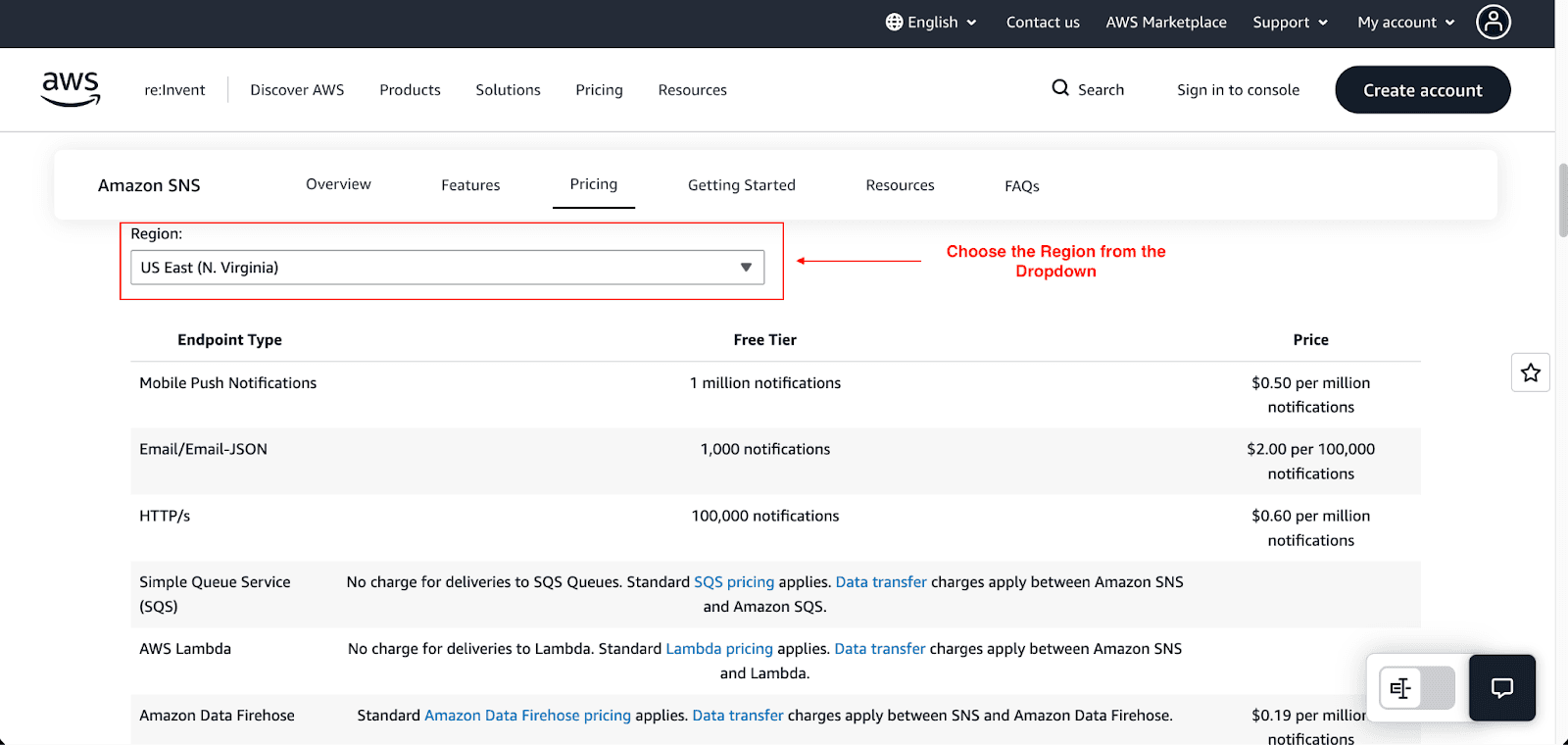
SNS pricing is based on the number of delivered notifications and published messages:
Message Publishing: Event-driven system architecture costs about $0.50 per million requests. You have to pay for every single message you publish to an SNS topic.
Message Delivery: You also pay for each message delivered to an endpoint, and this is a function of endpoint type (e.g., HTTP/S, email, SMS). Deliveries to Lambda functions are usually at no charge, while HTTP/S deliveries are charged at the rate of $0.06 per 1 million.
Free Tier: New accounts usually get free monthly deliveries and up to 1 million API requests, though this varies by region.
Costs are a function of (messages published × number of subscribers) × per-delivery cost, meaning workloads with many subscribers are going to be particularly expensive. For workloads with high fan-out, EventBridge is going to be a better and cheaper option, as it is going to decrease downstream invocations.
When to Use Each Service
Your choice between EventBridge and SNS should be driven by your specific needs.
Choose EventBridge
When you need sophisticated event routing and integration:
Complex Event-Driven Architectures: When your application needs to react to events coming from multiple sources and needs to route the events to different destinations based on the events or data contained in the events, EventBridge is the ideal choice.
SaaS Integrations: You can configure EventBridge to create workflows that respond to events from third-party services like Stripe, Zendesk, or GitHub, without having to build custom integration code.
Centralized Event Routing: When you need a single system for managing all the events in your system, event routing, filtering, and monitoring, an EventBridge event bus provides that central backbone.
Scheduled Events: If you need to run events on a schedule, EventBridge has a great event scheduler that can trigger events based on cron jobs, which is useful for batch jobs or running periodic tasks.
Choose SNS
For high-throughput, simple fan-out messaging and notifications:
Broadcast Notifications: If you have to send the same message to a lot of subscribers at the same time, this is what SNS is built for.
Real-Time Push Notifications: If you need to deliver notifications to your users in real-time via mobile push (SMS), other direct channels, or email, SNS is definitely the right service.
Simple Decoupling: For straightforward microservice communication where one service needs to notify several others about an event without complex filtering, SNS is a simple and effective solution.
Can They Be Used Together?
Yes! EventBridge and SNS are quite often deployed together in a robust hybrid architecture that merges the smart filtering and routing functionality of EventBridge with the high throughput and fan-out messaging affordance of SNS.
Here is how the pattern works:
EventBridge filters and validates incoming events according to user-defined rules.
EventBridge transforms the event payload if necessary, ensuring it's in the correct format for downstream services.
EventBridge forwards the processed event to an SNS topic.
SNS broadcasts the event to a multitude of subscribers simultaneously.
Let's look at an example:
Imagine AWS emits an EC2 instance shutdown event:
An EventBridge rule can be configured to filter specifically for 'stopped' EC2 events.
EventBridge then normalizes the event payload, extracting key details for easier consumption.
This normalized event is forwarded to an SNS topic.
The SNS topic then broadcasts an alert to various subscribers, such as:
- On-call engineers via email
- A Slack webhook for team notifications
- An SQS queue for audit logging
- A mobile push notification service
Conclusion
Think of EventBridge and SNS not as competing services, but as two complementary building blocks:
Use SNS when you need to notify many subscribers quickly.
Use EventBridge when you need to route, filter, transform, or orchestrate events.
Use them together to build scalable, clean, event-driven systems that are both cost-efficient and maintainable.
I hope this article has helped you understand the key differences between EventBridge and SNS, and how they differ, allowing you to understand their respective strengths to deploy systems with an architecture that scales, while keeping costs and complexity in control.
Join Pump for Free
If you are an early-stage startup that wants to save on cloud costs, use this opportunity. If you are a start-up business owner who wants to cut down the cost of using the cloud, then this is your chance. Pump helps you save up to 60% in cloud costs, and the best thing about it is that it is absolutely free!
Pump provides personalized solutions that allow you to effectively manage and optimize your Azure, GCP, and AWS spending. Take complete control over your cloud expenses and ensure that you get the most from what you have invested. Who would pay more when we can save better?
Are you ready to take control of your cloud expenses?