All blogs
10 mins
Amazon MemoryDB vs ElastiCache: Which Should You Choose?
Piyush-Kalra


With cloud app integration, there’s a growing need for applications to reach more customers and handle more data. Keeping a database on a traditional disk-based storage system leads to increasingly more application performance problems as user expectations continue to increase. As such, developers seek solutions to handle millions of requests in as little time as possible. This is one of the reasons a Redis-compatible database is a fundamental component of modern software architecture.
There is a performance-intensive requirement for real-time applications hosted in the cloud, especially for the latest AI applications, real-time analytics, competitive gaming applications, and global chat applications. AWS offers two of the most compelling options in the market in its ElastiCache and Amazon MemoryDB services.
Both services allow for real-time applications to use an in-memory database. Amazon MemoryDB acts as a highly durable in-memory database, while ElastiCache is a caching service that allows users to offer storage services at an extremely low latency. The selection of either service has a tremendous impact on the speed, reliability, and cost of an organization’s cloud infrastructure.
What Is Amazon MemoryDB?

(Image Source: AWS)
Amazon MemoryDB is a fully managed, Redis-compatible database built specifically for cloud-native applications. While other traditional caching services only offer a layer of storage that is lost for a restart, MemoryDB is designed to be a durable primary database, offering an in-memory storage solution. It relies on a multi-AZ transactional log to provide durability and keep your data safe, even when the underlying cloud infrastructure fails.
The reliability and durability of traditional databases and the extreme speed of in-memory databases are the two components the engineering of MemoryDB is aimed at combining in an optimal solution.
Key Features
Durability: Before confirming to the application that the write operation was successful, the operation is recorded to a distributed transaction log.
Redis compatibility: If you are already familiar with flexible data structures, APIs, and commands, you can use the same commands.
Multi-region resilience: Your data replicates automatically across multiple Availability Zones (AZs) to ensure data safety.
High availability: The service allows rapid failover, fast recovery of your database, and seamless restarts of your nodes without losing the critical state of the database.
What Is Amazon ElastiCache?
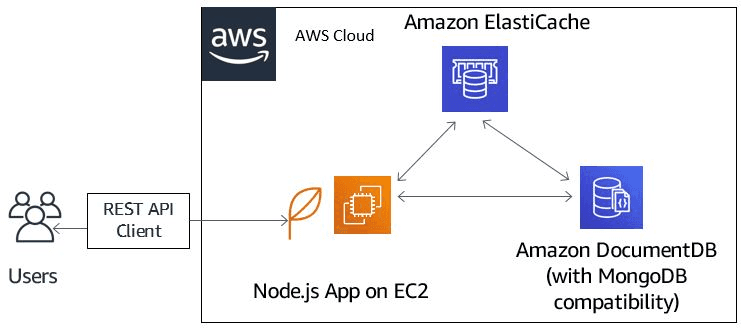
(Image Source: AWS)
Amazon ElastiCache is a fully managed caching service that accelerates application performance. ElastiCache offers support for Redis OSS, Valkey, and Memcached, which are the most commonly used open-source caching technologies. Because fast in-memory caches cost far less than the time it takes to query a backend database, application caches can be orders of magnitude faster than database queries.
ElastiCache is designed to achieve microsecond read times. ElastiCache can take bytes of data and serve them to applications in a fraction of a second.
Key Features
Ultra-fast caching: Access data in microseconds, drastically improving application responsiveness.
Auto-scaling: ElastiCache Serverless can self-scale based on compute, memory, and network usage.
Read replicas: Replicate ElastiCache instances to manage spikes in read request traffic.
Cost-efficient caching: Save on your overall infrastructure cost by having the ElastiCache instance perform all the expensive queries instead of your primary database.
Core Difference Between MemoryDB and ElastiCache
MemoryDB and ElastiCache differ primarily on their data persistence assurance. ElastiCache is high-speed, temporary storage, whereas MemoryDB is a durable, Redis database experience.
Feature | MemoryDB | ElastiCache |
Primary Purpose | Durable database | High-speed cache |
Data Durability | Yes | Limited |
Redis Compatibility | Yes | Yes |
Persistence Model | Transaction log | Snapshot/AOF |
Latency | Low | Extremely low |
Best For | Real-time apps | Caching workloads |
This Redis cache comparison highlights that architecture dictates use case. MemoryDB safely holds primary records, while ElastiCache speeds up access to data permanently stored elsewhere.
MemoryDB Architecture Explained
MemoryDB architecture uniquely relies on AWS's assurance of Redis durability. It uses a log-first architecture and a multi-AZ transactional log as a backend design.
How MemoryDB stores data
MemoryDB can ensure the entire dataset resides in memory, allowing for rapid reads. However, it separates the computation of writes from the storage.
Write path explained
When a write is made, MemoryDB sends the data to a highly durable, distributed, multi-AZ transaction log. The primary node will only respond to the write request as successful once the transaction log has safely stored the data.
Failover handling
During failover, when the primary node is lost, the system promotes a replica to be the primary in its place. As the new primary is using the independent multi-AZ transaction log, there is no data loss.
ElastiCache Architecture Explained
ElastiCache architecture uses the more traditional primary-replica model and utilizes an in-memory design for storage that's rapid but not as durable.
How caching reduces latency
The first step of your application is to check ElastiCache. If the information is cached (cache hit), it is retrieved in microseconds. But when the information is not in ElastiCache (a cache miss), it retrieves the information from the primary database, and ElastiCache is updated with the database information.
Read-heavy workload optimization
With ElastiCache, you can configure your cluster mode to shard the cache, and you can also add more read replicas as needed to support millions of queries at the same time. This also helps manage the traffic to your primary database.
Scaling horizontally
Horizontally scaling Redis caching architectures typically includes Valkey support. AWS now provides Valkey as a performant, open-source alternative to Redis OSS. Valkey provides stability and cost savings in the long term and allows for high-efficiency horizontal scaling of the application.
Performance Comparison: MemoryDB vs ElastiCache
When evaluating ElastiCache performance against MemoryDB latency, the results depend entirely on your specific workload.
Latency Comparison
ElastiCache easily wins for pure caching. Because it acknowledges writes immediately upon processing them in memory, write latency sits at roughly 200 to 500 microseconds. MemoryDB waits for the transaction log to secure the data, resulting in single-digit millisecond write latency (typically 3-5 milliseconds). Both services deliver microsecond read latency.
Throughput Comparison
Both services process millions of operations per second. You scale throughput similarly by adding shards and modifying node sizes.
Durability Impact on Speed
The MemoryDB write durability overhead is the cost of data safety. That slight delay in write acknowledgement ensures zero data loss, which is a mandatory requirement for systems of record.
Benchmark Considerations
Any Redis benchmark AWS provides will vary based on node sizes, network performance, and workload types. Always test your specific application access patterns.
Workload | Better Choice |
API caching | ElastiCache |
Durable session storage | MemoryDB |
Leaderboards | Both |
AI memory | MemoryDB |
High-frequency reads | ElastiCache |
Pricing Comparison
Understanding MemoryDB pricing and ElastiCache pricing helps you forecast your AWS Redis cost accurately.
MemoryDB Pricing Model
MemoryDB bills based on provisioned nodes, the volume of data written, and snapshot storage. Because it provides a durable transaction log, node costs are generally higher than equivalent ElastiCache instances.
ElastiCache Pricing Model
ElastiCache mostly involves node-based caching costs or serverless data storage charges. You pay for the memory capacity and compute power required to serve your cache.
Hidden Cost Considerations
Always account for replication, backups, and cross-AZ traffic. Adding replicas for high availability doubles or triples your node costs. Furthermore, running ElastiCache alongside a separate durable database (like Amazon RDS) often costs more than running a single MemoryDB cluster that handles both duties.
Scenario | More Cost-Effective |
Simple caching | ElastiCache |
Durable low-latency DB | MemoryDB |
Temporary sessions | ElastiCache |
Persistent real-time apps | MemoryDB |
When Should You Use Amazon MemoryDB?
MemoryDB serves as a highly reliable system of record. It completely eliminates the need to run a cache and a database separately.
Best For:
Real-time applications needing durability
AI conversational memory
Gaming state management
Financial systems
User profiles
Use MemoryDB if:
You need strict data persistence.
Downtime or data loss is entirely unacceptable.
You want the simplicity of Redis combined with enterprise database durability.
Need help optimizing Redis infrastructure costs on AWS? Contact our cloud architecture team today.
When Should You Use ElastiCache?
ElastiCache excels at protecting slower databases from traffic spikes and accelerating read times to absolute minimums.
Best For:
Traditional caching
Read-heavy systems
CDN acceleration
E-commerce applications
High-speed APIs
Use ElastiCache if:
Cache misses are acceptable and easily recovered from the primary database.
Absolute maximum speed matters most.
You want lower infrastructure costs.
Implementing cost-performance optimization requires careful AWS scaling strategies to match your node sizes to your actual traffic.
Which Service Performs Better for AI and Real-Time Apps?
Generative AI applications require rapid access to vast amounts of context. Finding the best AWS database for AI apps depends on how your agent processes information.
MemoryDB for AI Agents
MemoryDB stands out as a highly effective AI memory database AWS offers. It provides persistent memory for long-running AI agents, ensuring conversational context survives application restarts. It also supports vector search natively, allowing developers to cache vector-related metadata alongside standard data.
ElastiCache for AI Inference
For pure speed, ElastiCache acts as an incredible tool for AI inference. It provides fast response caching for common LLM queries. By caching prompts and accelerating embedding retrieval, it drastically reduces API costs to external AI providers.
Hybrid Architecture Approach
Many cutting-edge companies actually use both services for Redis for GenAI workloads. They deploy ElastiCache for the hot cache to handle immediate prompt lookups, and they rely on MemoryDB for durable state management to track long-term user context.
Conclusion
Both services leverage the power of Redis-compatible data structures, but they solve fundamentally different engineering problems. ElastiCache operates as a speed-first cache designed to accelerate your existing architecture. MemoryDB stands alone as a durable Redis database capable of safely securing your primary data.
If You Need... | Choose |
Fast caching | ElastiCache |
Durable Redis database | MemoryDB |
AI conversational memory | MemoryDB |
Lower cost caching | ElastiCache |
Persistent real-time state | MemoryDB |
Review your application's tolerance for data loss. If you can fetch lost data from a backend server, utilize the speed of ElastiCache. If losing that memory means losing customer data, invest in the durability of MemoryDB.
Need help optimizing AWS Redis costs? Looking for the right architecture for AI workloads? Talk to our cloud experts before scaling your Redis infrastructure.
Join Pump for Free
If you are an early-stage startup that wants to save on cloud costs, use this opportunity. If you are a start-up business owner who wants to cut down the cost of using the cloud, then this is your chance. Pump helps you save up to 60% in cloud costs, and the best thing about it is that it is absolutely free!
Pump provides personalized solutions that allow you to effectively manage and optimize your Azure, GCP, and AWS spending. Take complete control over your cloud expenses and ensure that you get the most from what you have invested. Who would pay more when we can save better?
Are you ready to take control of your cloud expenses?
Similar Blog Posts
AWS ElastiCache Pricing - Cost & Performance Guide
AWS Storage Gateway: What It Is, Features & Pricing